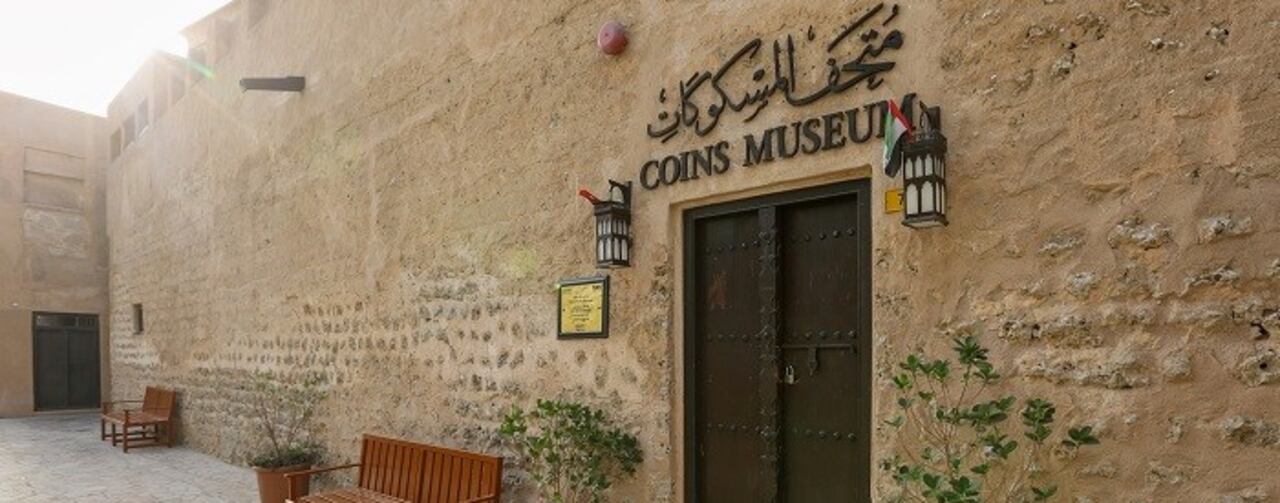
The Dubai Coins Museum sits in the Al Fahidi Historical Neighbourhood, the oldest surviving residential quarter in Dubai, where traditional wind-tower architecture and narrow lanes frame the city's history. The compact museum is free to enter and offers guided tours led by Emirati staff who walk visitors through the collection. Visitors should note that Google Maps directions to the museum are inaccurate; security guards at Al Fahidi can point the way.
The collection spans millennia of monetary systems, from ancient trade tokens such as cowrie shells, pearls and salt through early Islamic dirhams to contemporary Gulf coinage sourced from across the Arab world and beyond. The early Islamic coins are a particular focus, with objects spanning several centuries and multiple dynasties presented in historical context. Early Islamic dinars and dirhams are thin, text-heavy coins bearing Quranic inscriptions and caliphal names, with some holding as many as 160 words of Arabic calligraphy.
The museum traces the spread of Islamic monetary systems, the role of trade routes in shaping currency standards and the evolution of the dirham in what is now the United Arab Emirates. It chronicles the transition from when the Trucial States traded in Indian rupees through the first Qatar and Dubai riyals to commemorative coinage of recent decades. The collection includes rarities such as the Larin coin, a tweezer-shaped piece in circulation along the Arabian Gulf coast around 631 to 635 AD.
Interactive elements include a screen-based game where visitors can design and forge their own ancient coin to learn the minting process. The guided tour lasts about half an hour, though guides extend visits for visitors with questions. Entry is free and the museum operates daily from 8am to 5pm.